


Tags
Date
24 April 2026
Author
Le Anh Nguyen
Table of Contents
Share
Here’s a scenario many sales managers know well: you increase bonuses, launch a quarterly challenge, and revamp the Salesforce dashboard.
The result?
A peak in activity for three weeks, then back to normal. Your good sales reps remain good, your average sales reps remain average, and everyone waits for the next carrot. Studies have shown that during an incentive program, sales peak at the beginning, then again towards the end, before gradually returning to baseline levels (The Forum for People Performance Management and Measurement).
The problem isn’t the amount of the incentive. It’s that the mechanism itself is worn out.
Sales gamification starts from a different premise: people aren’t engaged by money; they’re engaged when they feel they’re progressing, visible, and part of something. What games naturally produce—immediate feedback, a sense of leveling up, healthy competition—can be replicated in a sales context. And it measurably changes results.
Key Takeaways:
- 43% of sales reps don’t meet their targets: This isn’t a talent problem; it’s a daily engagement problem.
- Animating partner networks – use cases: A network of resellers or distributors is inherently difficult to mobilize. Yet, this is where gamification yields its best results.
- Three types of gamification, three different objectives: Individual gamification to help each sales rep progress at their own pace, collective to create team dynamics, relational to engage clients and partners. Choosing the wrong mechanism guarantees failure.
- The leaderboard trap: A ranking where the same profiles appear every month doesn’t motivate the remaining 80%; it discourages them. The key is to value relative progress as much as absolute rank.
- The human factor: Without active managerial animation, even the best mechanisms run out of steam in a few weeks. The local manager remains the primary lever of engagement; the platform is their tool.
What is sales gamification?
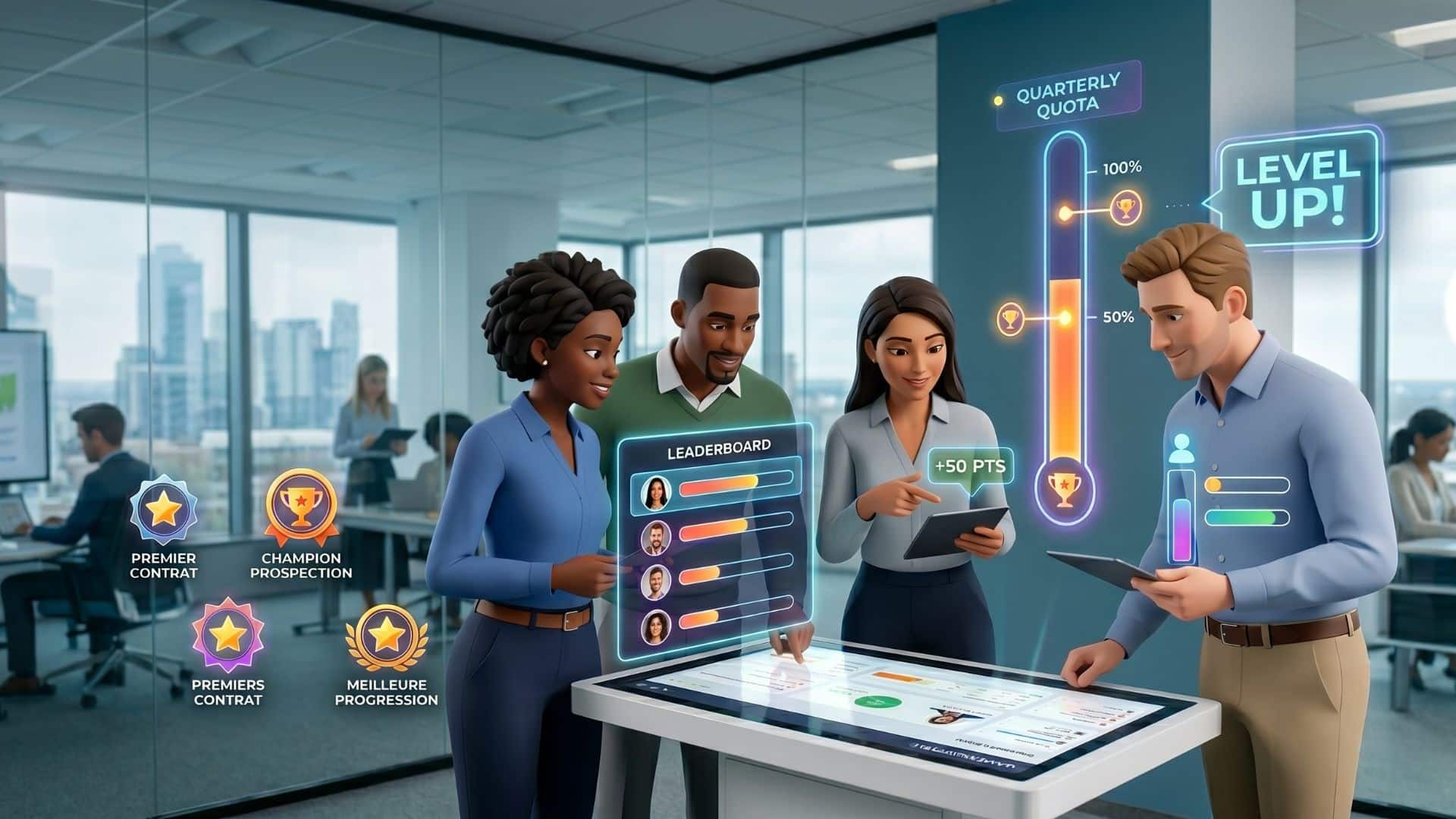
Sales gamification is the integration of game mechanics (points, badges, leaderboards, progressive challenges) into the daily lives of sales teams to guide their behavior and improve their results. It’s not a one-off event or an HR gimmick. It’s a management layer that transforms your KPIs into a lived experience for sales reps.
The important nuance: gamification is not “ludification” (playification). Adding confetti to a dashboard isn’t gamification. What matters is that game mechanics serve a precise business objective—a behavior to change, a habit to instill, a network to activate.
Why adopt sales gamification in business?
43% of sales reps don’t meet their targets. This is the figure McKinsey regularly cites, and Incenteev’s clients often find it in their own teams before deploying the platform. It’s not a problem of talent or training. It’s often a problem of daily engagement.
What makes gamification particularly relevant today is the dispersion of teams. A sales director who once managed a team on the same floor now has to animate field sales reps in ten regions, a network of independent resellers, and perhaps teams in several countries. Traditional tools—kick-off meetings, annual challenges, monthly reporting—no longer address this reality.
Gamification creates what major annual reviews don’t: continuity. A sales rep who sees their score evolve daily on their mobile, who receives a badge when they land their first major account, who moves up in the regional league—they remain engaged between sprints, not just during them.
What are the different types of sales gamification?
1. Individual gamification: progressing at your own pace
This is the most well-known mechanism, and often misused. A global leaderboard where the same ten profiles appear every month doesn’t motivate the remaining 80%—it discourages them.
What works is relative progress: each sales rep competes against their own baseline, not just against their colleagues. A beginner who improves their conversion rate by 12% in a month needs to see it, experience it, and share it. Progress badges (“First contract signed,” “Best prospecting week”) create the feedback that sales reps otherwise only get in semi-annual reviews.
2. Collective gamification: creating team dynamics
Collective challenges produce something that individual competition does not: solidarity. When the objective is shared—reaching 110% of the regional quota to unlock a common event, for example—good sales reps have an interest in helping others level up. This is the exact opposite of the perverse effect of pure individual ranking.
3. Relational gamification: activating partners and B2B networks
This is often the most powerful, and most underestimated, use case. A network of resellers or distributors is inherently difficult to animate: these partners are not your employees, they also sell your competitors’ products, and they don’t attend your meetings.
- Sage France understood this. By activating its network of 1200 resellers via Incenteev—with gamified prospecting challenges, regional leagues, and content directly accessible on the partner portal—the company achieved 318 million euros in revenue, 80% of which was generated by its distributors. The ROI of the program? 390%. And every year, more than 50 gamified prospecting operations mobilize the entire network.
- LG Electronics followed a similar logic to engage its HVAC installers in 15 countries. Twelve months after launching the partner program on Incenteev, over 20% of the division’s revenue was directly attributable to the program.
Explore our case studies to see how these strategies generate concrete results.
How to implement a sales gamification strategy?
Start with behavior, not mechanics
The question isn’t “which gamification tool to choose?” but “what sales behavior do we want to change?”. This answer determines everything. Do you want to increase prospecting volume? A leaderboard on calls made is relevant. Do you want to improve the quality of appointments? Badges on conversion rates at each stage will be more effective. Do you want to accelerate the adoption of a new CRM? A gamified learning path with progressive validation, like what Orange implemented to train 2500 employees on Salesforce—will be your best lever.
Connect gamification to your existing data
A gamification platform that operates in a silo has no value. What creates engagement is when sales reps see their own data, their real CRM figures, their field results transform into a real-time score. No re-entry, no week-long delay. Live data feeds the mechanism, and the mechanism changes behavior.
Mistakes that cause a gamification program to fail
- The leaderboard that freezes ranks. If the same profiles dominate week after week, those at the bottom of the ranking quickly disengage. The solution: segment by experience level, value relative progress, or mix individual ranking with collective challenges.
- Rewards nobody wants. A €50 gift card for the sales rep of the month in a CAC 40 company is symbolically devaluing. Public recognition, status progression, and shared experiences often have more impact than isolated financial rewards.
- Gamification without a manager. This is perhaps the most common mistake. The platform can do everything in terms of mechanics, but if the local manager doesn’t animate the challenges, doesn’t comment on the ranking, doesn’t highlight progress in team meetings—the system runs out of steam in four weeks. Henkel integrated this well into its deployment across 14 countries: the success of the product line launch (31% annual growth, 20% above forecasts) relies as much on managerial animation as on the mechanism itself.
Discover other mistakes to avoid in our complete article.
How to measure the ROI of sales gamification?
Three indicators are sufficient to manage a gamification program in the first 90 days:
- The adoption rate of the platform (on Incenteev, the average is 92%—which is not guaranteed for all tools).
- The evolution of business KPIs before/after over 30 then 90 days—conversion, prospecting volume, average basket depending on the objective.
- The team engagement score, measured by connection frequency and challenge participation.
One of the least monitored, yet very revealing, indicators: the intermediate ranking. If your mid-table sales reps are progressing, your program is working. If only top performers are involved, you have a calibration problem.
Conclusion
Sales gamification is not a management fad. Over 10 years and more than 650 million euros in additional revenue generated for its clients, Incenteev has documented what works and what doesn’t. The conclusion is always the same: mechanics matter, but what makes the difference is the precision with which they are aligned with real behavior, in a real context, with a manager who plays along.
Frequently Asked Questions about Sales Gamification (FAQ)
Other Articles You might be Interested in:


Tags
Date
24 April 2026
Author
Le Anh Nguyen